Lifting keel

Design
The Southerly 95 is a Dick Carter design with a cast iron ballast plate protecting the keel and bottom when grounding. Southerlys are renowned for their ability to float “on a damp lawn” and with the keel raised by the hydraulic ram she only draws 1’10”, but with the keel down she draws 5’10” and can give a good account of herself to windward. The keel sits in a massive steel grounding plate, which not only protects it but also provides a substantial contribution to the ballast.
The original keel had a weak point at the top because the lifting bracket was part of the casting. The metal was quite thin at this point and matters were made worse by siting a slot for the keel locking pin immediately below the bracket. The original design can be seen on the right with the lifting point just protruding through the slot. Northshore altered the design in later models by removing the top part of the casting and bolting a bracket directly to the keel. Fortunately, it is quite easy to upgrade to the later design by grinding the lifting point flat and bolting on the new bracket. The modification is completely effective but is not cheap.
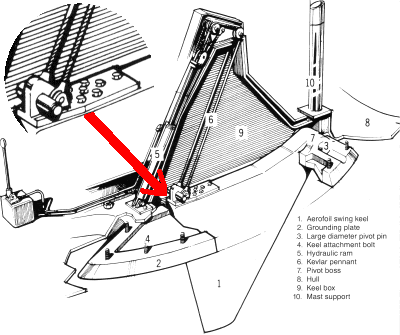
Keel Bracket Upgrade
The new bracket is shown on the right. Mistroma had one fitted in 1986 and that lasted until 2006 when I decided that it was beginning to look rather corroded. I took the opportunity to fit an even heavier bracket made from 2” thick plate and also replaced the 12mm pennants with 14mm Dyneema (kevlar). The pivot pin is massive and showed no sign of wear. The keel was cleaned up and repainted after replacing the bracket. I confidently expect the new bracket to last well in excess of 20 years.
July 1987: New keel bracket fitted
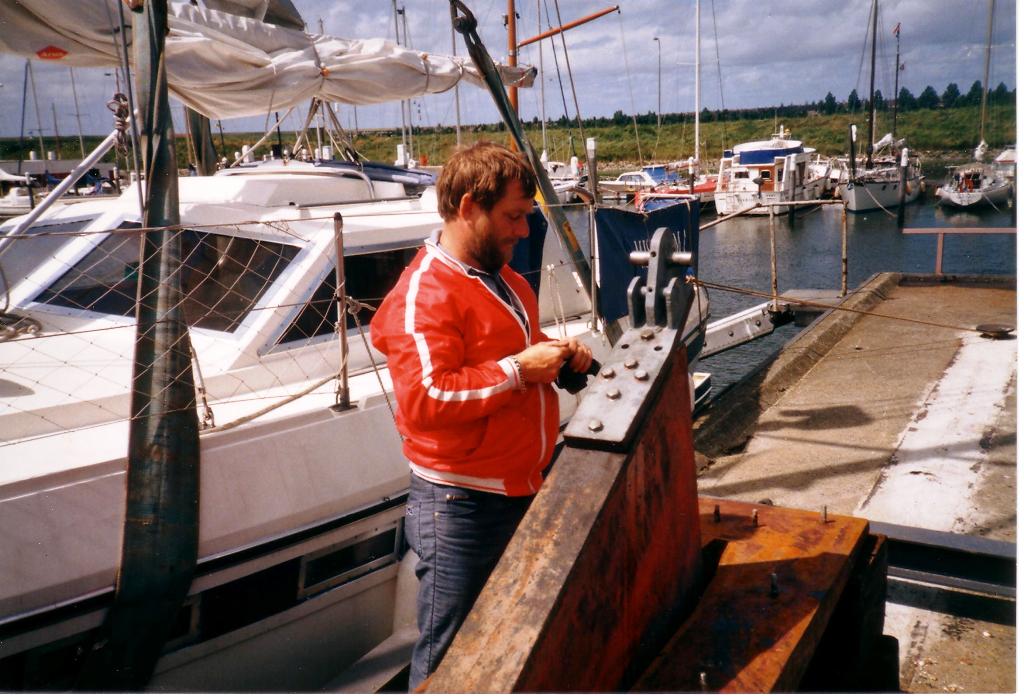
July 1987: Hull lowered back in place

Jan 2006: New keel bracket fitted
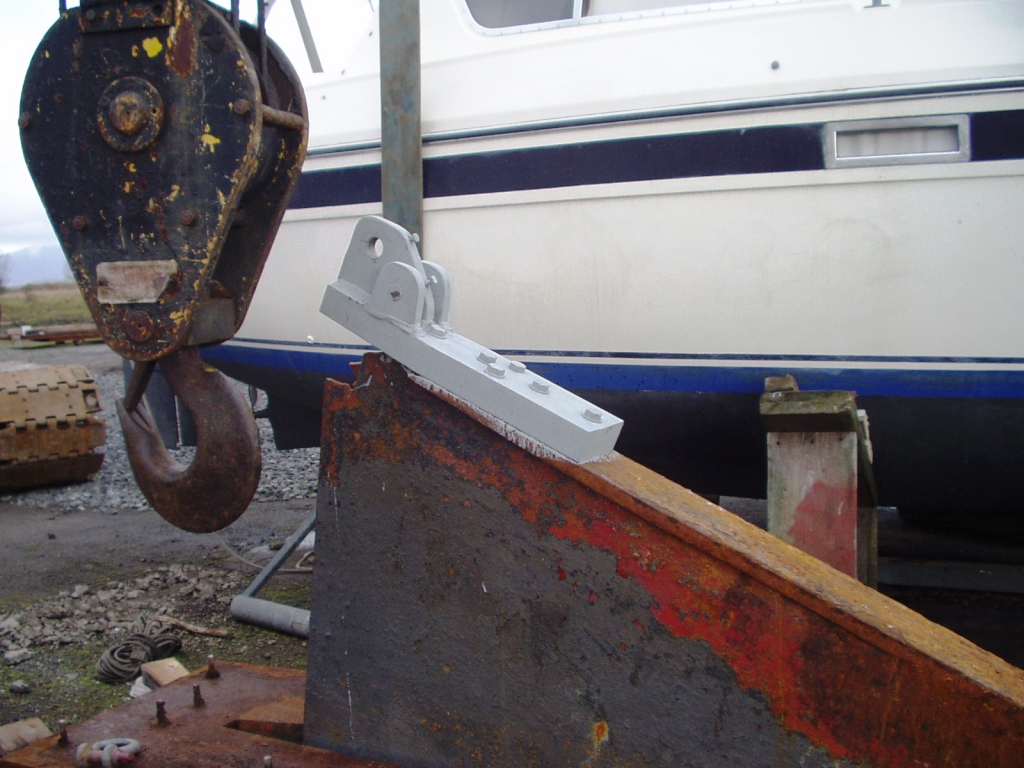
Advantages
One of the best things about owning a Southerly is the carefree attitude you develop to "running aground". Obviously you don't want to deliberately ram a rocky outcrop. However, the combination of extremely shallow draft and a massive grounding plate is the ideal setup for drying out.
It is really great to get into places later and leave earlier than other boats or take short-cuts. We've often sailed past a cluster of boats and into an empty harbour whilst they remain anchored in a swell waiting for the tide for an hour or more.
The variable draft allows you to feel your way into an anchorage secure in the knowledge that the keel can always be lifted a little to allow a safe exit. By the time the keel is fully retracted the bottom is usually visible and any obstructions are easily seen.
Many harbours and anchorages are protected by a bar. Consequently, we've dried out in many places where the swell completely vanishes towards the bottom of the tide. Bilge keel boats have dried earlier when there was still some swell. Craft with less draft also have more flexibility about where to moor and can tuck further into a sheltered spot.
Loads are spread over a much larger surface area when the boat does finally touch bottom. This not only reduces point loads on the hull it also provides significant damping due to suction between hull and sand or mud. Mistroma usually settles on the ground very gently indeed. We've always felt safe in the knowledge that she actually sits on a huge grounding plate and contact is a with cast iron plate up to 6 inches thick rather than a fibre glass hull.
Mistroma is very stable when dried out and usually ends up pretty level in most circumstances. Bilge keel boats tilt at an angle when they dry out side on to a slope, as one keel is lower than the other. Southerlies stay more level because they contact the ground at the centre line. If the bottom is even slightly soft, they end up sitting in a slight depression that holds the hull firmly upright.
Disadvantages
Every design has some sort of downside. Mistroma's high topsides give a lot of accommodation even with her shallow draft. Unfortunately, this makes her a little difficult to control at slow speed when it's windy. Oddly enough this is much more of a problem in deep water rather than shallow water (see handling tip below). We've never really considered this a huge problem and gladly accept it to get the advantages.
The hydraulic lift keel is more complicated than a fixed keel and this makes Southerlies more expensive than an equivalent fixed keel. Maintenance does cost a little more. However, I can't really complain as we've only had 2 keel related problems in 20 years and the recent maintenance work should be good for another 20 years.
Handling Tip
Mistroma is easy to handle in shallow water with one person on the helm and one controlling the keel. Raise the keel a few inches and approach the harbour or anchorage, safe in the knowledge that the keel will simply slide backwards and upwards if you do touch. In sand or mud any contact will not be noticed and the keel simply tracks through the silt. Raise the keel as required to maintain forward speed. Simply lower the keel to park the boat in any spot. If a tight turn is required, simply raise the keel slightly and use the prop wash over the rudder to change direction without moving forward. Raise the keel when facing in the correct direction and continue forwards. Many people have been confused by the fact that we don't drift, aren't anchored but can move at will.
We tried to tie up beside a wall in Holland to wait for a bridge opening outside Goes when it was blowing a gale. There were no mooring points and it was pouring with rain. As it was only a few feet deep we sat with the keel in the mud, dry and warm, whilst a succession of other boats tried to tie up behind. Most only managed to get their bows close enough to get one person ashore and after standing in the rain for a while they gave up. When the bridge opened we simply lifted the keel to let the boat blow off the wall. A nearby English yacht hailed us to ask how we'd managed to "park" without ropes. They were convinced we were hard aground and stuck but were surprised to see us move when required and were very surprised at my answer. "I just used the handbrake" and that term stuck for the next 20 years where we'd stop a few feet from the side and tie up a short while afterwards.
